The history of the Collie goes back to Celtic tribes
who brought herding dogs to the British Isles
before the time of Christ. From those dogs were
derived a number of pastoral breeds and types of
dogs all dubbed "Collie", the Celtic word for "useful". The Bearded Collie, the Border Collie,
the Shetland Collie (later renamed the
Shetland Sheepdog) and the breed we today call
simply the Collie (in either the rough or smooth
variety) all trace back to these "useful" herding
dogs.
On board, as well, during the 1920's and 1930's
was a well loved American writer by the name of
Albert Payson Terhune. As a breeder, fancier, and
author, Terhune was in the unique position of being
able to bring to the public an abiding love and
deep respect for the Collie that caught the
imagination of just about everyone. His talent for
bringing the loyal and uncanny nature of the breed
alive on paper fostered a genuine desire in the
reader to come to own such a dog for himself.
To this day, many is the Collie fancier who's
introduction to the breed was a book by
Albert Payson Terhune.
While the breed's popularity in Scotland and in
England throughout the 1800's is legendary, the dog considered to be the foundation sire of all
modern day Collies was of Irish origin. The Irish
had developed a type of dog they called the
Galway Collie, and it is from one of these dogs
that all modern day Collies derive. This individual
was a tri color rough coated dog named Trefoil.
Born in 1873, he is the traceable ancestor of all
Collies today.
It was not long before the breed issuing forth from
Trefoil's offspring came to the interest of
American dog fanciers. In fact, it was only 13
years after the birth of Trefoil, 1886, that the
Collie Club of America was founded.
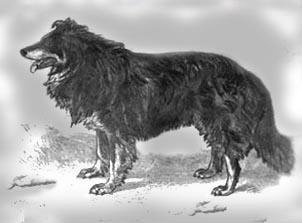
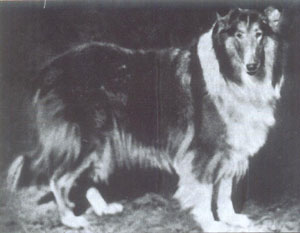
Trefoil
born 1873
Collies became extremely popular in the U.S.
right from the start. Their herding ability, coupled
with their intuitive nature, their extreme gentleness
with other creatures - especially children, and their
protective devotion quickly brought them attention
as the ideal ranch, farm, and family dog.
It was common practice throughout the late 1880'S
and early 1900's for well heeled American
entrepreneurs such as James Watson and
J.P. Morgan to import the top winning and
producing Collies from England into the U.S.
to establish the foundation of the American Collie.
Because both a show record and a record of
producing top quality offspring also able to win
in the show ring were required of these dogs, many
were imported at ages we would today consider to
be "older" and even "senior". Yet the fact that
these dogs were highly regarded and priced at
top dollar (many even by today's standards!) is
testament to the longevity of the dogs who became
the foundation of our breed. It is also historically
significant to note that due to this practice, the
foundation of both the British Collie of today and
the American Collie of today lies in the same
top producing and long lived champions of that
era..
It is interesting to note that while his skill and talent
as a writer was unquestionably his main contribution to the popularity of the Collie,
Terhune's efforts as a breeder were also enduring.
Ch. Sunnybank Thane, born in 1927, was bred and
owned by Albert Payson Terhune. He is among a
number of Terhune's Sunnybank Collies who
can be found in the pedigrees of many, if not most
American Collies today -- including the Collies of
Littlefield.
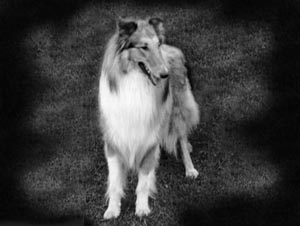
In 1939, the American public was introduced to
Eric Knight's fictional Collie character, Lassie; first
through a short story in the popular magazine,
The Saturday Evening Post, and laterthrough the
best selling novel, Lassie Come Home.
In 1942, MGM Studios made a highly successful
film of that movie, followed closely by six more
films casting movie dog trainer
Rudd Weatherwax's impeccably trained Collie
in the role.
As the popularity of the Collie breed had already
been firmly established in the hearts of the
American public, the intuitive and empathetic
Lassie character was a predictable success.
With the advent of television in the 1950's, the
then well established Lassie icon moved to the
small screen, again with Rudd Weatherwax and
later his son Bob at the helm. The two trained
numerous dogs to play the role of what was to
become the world's most famous fictional
canine.
The series enjoyed a 19 year run, ultimately
bringing a Collie dog into the homes of countless
families throughout the world on a weekly basis well into the early 1970's.
For the breed, the popularity of Lassie proved to
be a mixed blessing. The idea that the Collie was
highly intelligent, intuitive, and wonderful with
children as well as with other animals was surely
an honest representation of the breed. The idea
that the Collie was exclusively a rough coated sable
and white dog, however, became unfortunately
established in the minds of the public. That
often resulted in the beautiful tri color, blue merle,
white, and smooth coated Collies of the era
being overlooked by many pet buyers inflamed
with the mania of owning, not primarily a Collie
dog, but a "Lassie" dog - a sable and white
rough.. To add to the confusion, the initial dog
who portrayed the icon happened to sport a white
face blaze, typical of Collies in the '20's and 30's.
By the 1940's, however, breeders began moving
away from producing dogs with large amounts of
white on the face, as it often accompanied
undesirable white haws or inner eyelids which
can detract from the true Collie expression.
Hollywood, however, continued to portray their
Lassie character using a dog who sported the
face blaze. This resulted in many prospective
pet buyers seeking out the blaze to the frustration
of Collie breeders of the time. Additionally,
it spawned a plethora of "Lassie type" Collie
breeders who had little regard for or
understanding of issues regarding husbandry,
breed type, pedigree and conformation
quality. Thankfully, those breeders have pretty
much disappeared along with the vast popularity
of the Lassie character.
By the 1920's, the U.S. Collie fancy had a
solid foundation on which to base the
breeding programs which would set the type
future caretakers of the breed in this country would
strive to maintain. Important contributions to the
development of the American Collie were made in
that decade by breeders such as Florence Ilch of
Bellhaven, Clara Lunt of Alstead, Dr. O. P . Bennett of Tazewell , W.R. Van Dyck of Honeybrook,
Charles and Lillian Wernsman of Arken,
Dorothy Long of Noranda, Edwin Pickhardt
of Sterling, and Elizabeth Browning of Tokalon.
Ch. Magnet
born 1912
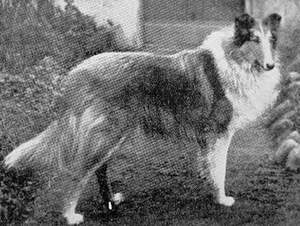
Ch. Sunnybank Thane
born 1927
Expressing the true joy every Collie breeder feels
on finding that special puppy in a long planned
litter, Terhune wrote of Thane;
"I had been saving up that half-royal Scottish title, for years; waiting for a dog that should merit it. In this pale gold youngster's deepset dark eyes, almost from birth, I read the true look of eagles; the look I had been watching for so long. In his ungainly and pudgily overgrown baby body I read a future of mighty bone and lion-like power and symmetry and of tremendous coat. Here was a born champion. Here was a pup preordained to wear my stored-up name of Thane."
Attesting to Thane's temperament and personality,
he further wrote;
"Now and then—as in Thane's case—I try to produce a fine show specimen. Sometimes I succeed. Sometimes I do not. Sometimes—once in a great while, as with Thane—I can evolve a dog which combines both the inner and the outer traits I am looking for."
Thane finished his championship in just five
shows. and was, according to Terhune, acclaimed
by all who saw him as "the greatest Collie of
the decade". Whether or not that assessment is
true is, of course, a matter for others to debate,
but here in New Jersey we are more than proud to
proclaim the finest of the Sunnybank Collies
of Pompton Lakes, NJ to be in the pedigrees of our own beloved champions today. [for more on
Ch Sunnybank Thane, and on
Albert Payson Terhune, you can click on
Thane's photo]
During the decades of the 1950's and 1960's, the
Collie breed came to represent numbers of dogs
portrayed in books, magazine articles, and films
as the epitome of loyalty, bravery, and the utmost
not only the first dog to receive the annual award,
but the most awarded breed in the full history of
the honor.
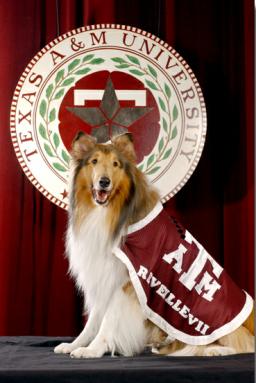
In 1931, one of America's top universities and top
agricultural schools began the tradition of having as
it's school mascot a Collie named Reveille.
Texas A&M University so highly regards their
Collie mascot that she is called the first lady of
Aggieland. Even beyond that, Reveille
is the highest ranking member of the university's
Corps of Cadets, and the only bearer of five
silver diamonds. (The Commander of the Corps
of Cadets has only four silver diamonds)
Freshman students are required to address Reveille
as "Miss Rev M'am", and she is the only dog
(except for service dogs) allowed in all campus
buildings. Reveille has her own cell phone, her
own student I.D. card, and, naturally, her own
personal assistant who accompanies her
everywhere. She attends all school functions and sporting events, and attends class with the student known as the Mascot Corporal, a sophomore class member who is her designated assistant for the year. Tradition requires that if Reveille barks in class, class is canceled. As of this writing, the current Reveille was introduced in August 2008, and is officially known as Reveille VIII.
The 1970's are considered by many to be a
heyday for the Collie breed with a plethora of
outstanding champions gracing the show ring
during that era. While kennels of this time were
typically smaller than those of the 1920's of a
half century earlier, they were no less based on
the establishing of recognizable lines and families
of Collies designed to preserve and maintain the
qualities of physical soundness, esthetic beauty,
solid temperament, and engaging personality on
which the breed was founded.
The premiere sire of that time was a
sable and white rough Collie by the name of
Ch. Tartanside The Gladiator. "Buster", as he
was affectionately known, was born in 1969.
He was bred, owned and cherished by John Buddie
of Tartanside Collies. This incredible dog became
the sire of 49 champions, and the foundation sire
of not only the Tartanside family of Collies, but
of a number of other families as well. He was a
multiple Best In Show and Group winner, and won
the Collie Club of America National Specialty
show not just once, but three times! His final
CCofA National win was from the Veterans Class,
a feat which was unprecedented in Collie history.
Probably best known for his beautiful face,
structural elegance, and unflappable temperament,
Buster was the top champion producing sire in the
breed for a number of years, and his positive
influence on the breed is still very much felt today.
Ch. Tartanside The Gladiator ROM
born 1969
Ch. Halbury Jean
born 1924
"The Mother Of The American Collie"
"The Father of the American Collie"
As we now move into the Collie's third century, we are blessed to have mentors from that heyday era to guide the next generation of breeders. Together we strive to maintain, promote, celebrate and love this glorious breed on into the future.